
Notre-Dame de Paris

Ivory edition,
€240.00
The Hunchback of Notre-Dame
French edition
Large format (14 x 10'')

free shipping Free shipping 

Ivory edition,
€240.00
The Hunchback of Notre-Dame
French edition
Large format (14 x 10'')

free shipping Free shipping 

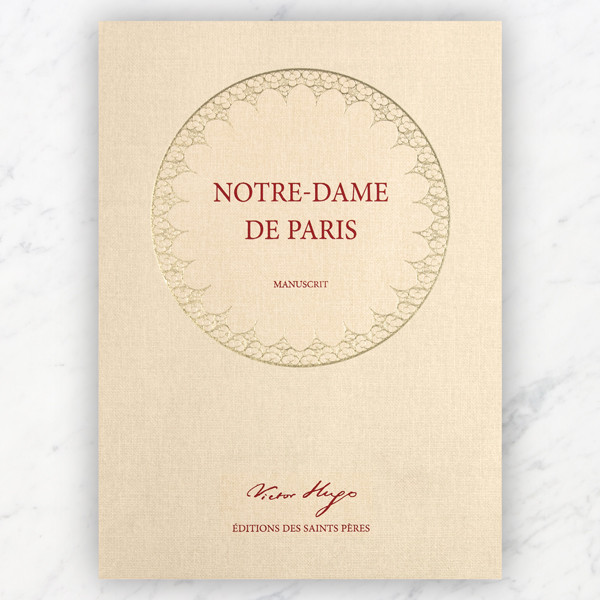
Notre-Dame de Paris, Victor Hugo's manuscript

Notre-Dame de Paris title manuscript

Conserved at the National Library of France (BnF), the full manuscript of Notre-Dame de Parisem> is published for the first time ever in France in our beautiful boxed set edition. It is a novel that Victor Hugo conceived of as ‘both drama and epic, picturesque but poetic, real but ideal, true but great, which inscribes Walter Scott in Homer.’

cathedral Notre-Dame's engraving

An early career before Notre-Dame de Paris

From the age of 14, Hugo wanted to be ‘Chateaubriand or nothing.’ He created a literary periodical with his brothers (Le Conservateur littéraire) and wrote poems while he was a student at the Cordier boarding school in Paris. Encouraged by his mother, at 15 he took part in a poetry competition organised by the Académie Française on the theme ‘Happiness as dependent on study in all aspects of living’. His poem received an honourable mention. Soon afterwards, he began to rub shoulders with leading Romantic minds of the time, including Alfred de Vigny, Lamartine, Charles Nodier, and founded the literary circle Le Cénacle. His first poetry collection Odes was published in 1822, the same year he married his childhood friend Adèle Foucher. It signalled the beginning of a long and rich career at the forefront of French Romanticism, characterised by the scandalous reception of his play Hernani (1830).

The birth of the manuscript

Highly influenced by the English Gothic, and infatuated with the historical novel as well as the Medieval period, it was during this fruitful decade that Victor Hugo set out to write his very first masterpiece: Notre-Dame de Paris. In 1825, Hugo had already expressed his view on the importance of preserving French heritage (see Sur la destruction des monuments en France). Notre-Dame de Paris was intended to reinvigorate the general public’s attachment to the cathedral. In 1835, Hugo joined the Commission for Monuments and instigated the building’s restoration, which was approved by Louis-Philippe in 1844 and executed by the architect Violet le Duc.

For his writing, Victor Hugo researched extensively, amassing endless documents. He read the academic authorities on his subjects – Du Breul, Sauval, Commynes and Mathieu – to get a precise idea of events during the reign of Louis XI and the state of Paris at the end of the 15th century, which furnished his historical settings.

Fully absorbed by his novel and no doubt seized by a certain dizziness at the extent of his assemblage, he noted, ‘I pile up page upon page, and the material stretches and extends itself so far in front of me as I advance that I do not know if I won’t write up to the towers.'

Handwritten page of Notre-Dame de Paris

A cult classic

Notre-Dame de Paris first appeared in March 1831: it had been promised to Hugo’s publisher Charles Gosselin several years beforehand (the contract was signed in 1828), though it took Hugo three years to deliver the remarkable novel, which was inspired by the inscription ANÁIKH (fatality, in Greek) that he saw etched in the mythical cathedral of l’île de la Cité, Paris. The delay can be pinned to a lost notebook and a series of political events. In the manuscript, Hugo specifies: ‘I wrote the first three or four pages of Notre-Dame de Paris on July 25, 1830. The July revolution interrupted me [...]. I resumed writing Notre-Dame de Paris on September 1 and the work was completed on January 15, 1831.’

page manuscrite de Notre-Dame de Paris - Chapitre Claude Frollo

The novel was met with immediate success on publication. In one month, four successive editions were released. The text was translated into multiple languages, and Hugo adapted it into an opera libretto in 1836. The adventures of Quasimodo, Esmeralda, Phoebus and Frollo can be seen in numerous ballets, musicals, plays and films.

The publication of the novel on 16 February 1831 passed on that day unnoticed, relegated to the background of other events that shook the capital – the funeral service in memory of the Duke of Berry at Saint Germain de l'Auxerrois which provoked a riot. A few days afterwards, the press finally took an interest in Notre-Dame de Paris. It was acclaimed by the public and critics alike, so much that Lamartine proclaimed: ‘It is the Shakespeare of the novel, a colossal work, an antediluvian stone, the epic of the Middle Ages! The author is raised above the towers of Notre-Dame!’, while Baudelaire affirmed Hugo’s ‘genius without limits’. In contrast, Balzac commented pithily: ‘Two beautiful scenes, three words, the whole implausible, two descriptions, beauty and the beast, and a deluge of bad taste; a fable without possibility and above all a boring, empty work, full of architectural pretension.’

The handnumbered print run
is sold out.
le tirage bleu des fleurs du mal est épuisé

The Oxford blue edition,
hand numbered, is sold out.


This Ivory edition
is unnumbered.


Suscribe to our newsletter &
keep up with our latest news
and publications.


The treasured manuscripts of Victor Hugo

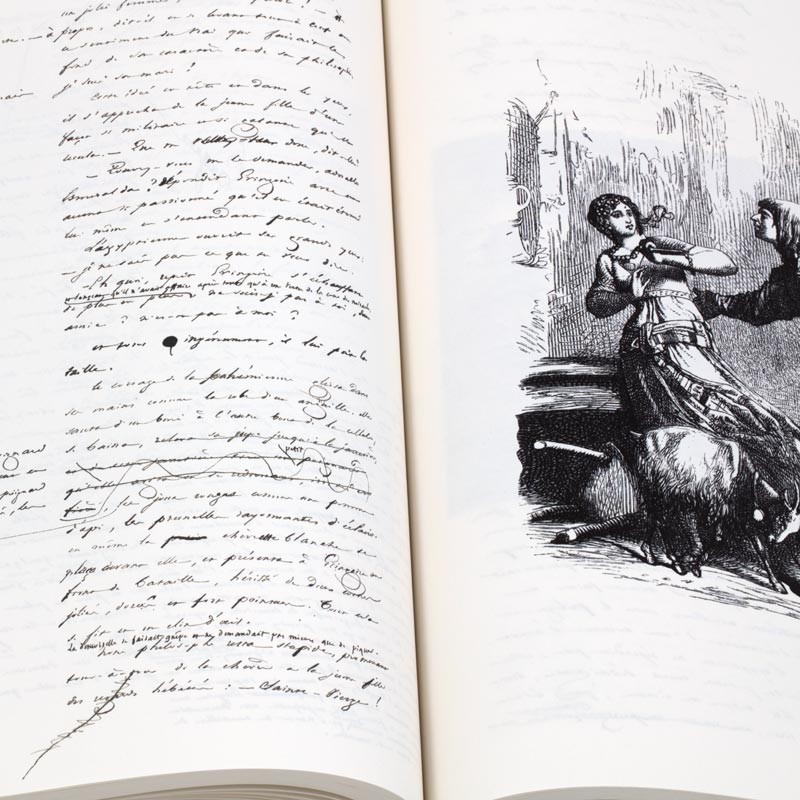
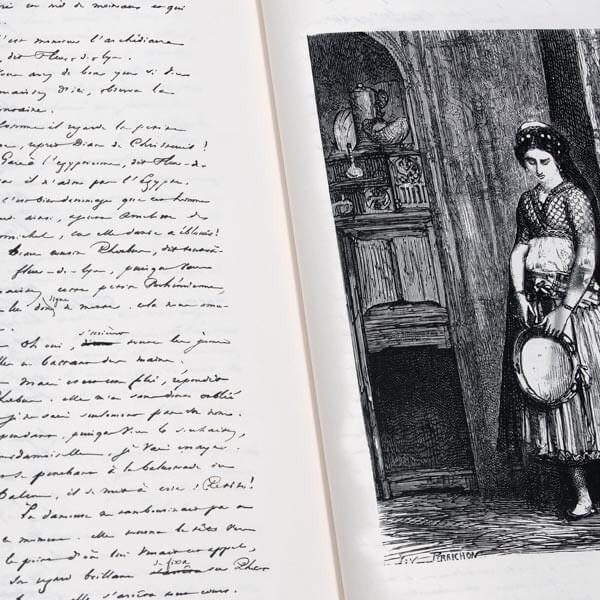
This manuscript was used for the first edition of the text. In the margins are the names of the typographers – Charles, Eugene, Lévi, Michel… to whom Hugo left instructions: ‘This is section 2 of Book 3. I will give you the rest after tomorrow morning.’ The descriptions and historical notations are often underlined, and the attentive reader will uncover intriguing elements within the pages: calculations, equations, several drawings of faces or animals, arabesques, and even a sketch of Quasimodo’s silhouette (see appendices). A few pages that were stolen from the printing press (from Chapter 2 of Book 9, “Hunchback; Borgne et Boiteux”) were rewritten by Hugo and found in 1902.

Victor Hugo took great care with his manuscripts. He chose his pens and papers carefully, and after his exile preferred to write on large bluish pages that he folded in half. He left margins on the left-hand side for additions, erasures, or sometimes sketches. Except for those gifted to his friends, his manuscripts were kept in a trunk watched over by his relatives (his mistress Juliette or her sister-in-law), who brought them with her between Brussels, Jersey and Guernsey.

A codicil to his will was added on 31 August 1881, for the attention of his executor Paul Meurice, confiding: ‘all that has been written or drawn by me is at the National Library of Paris, which will one day be the Library of the United States of Europe.’

quasimodo drawn by Victor Hugo

A Deluxe edition

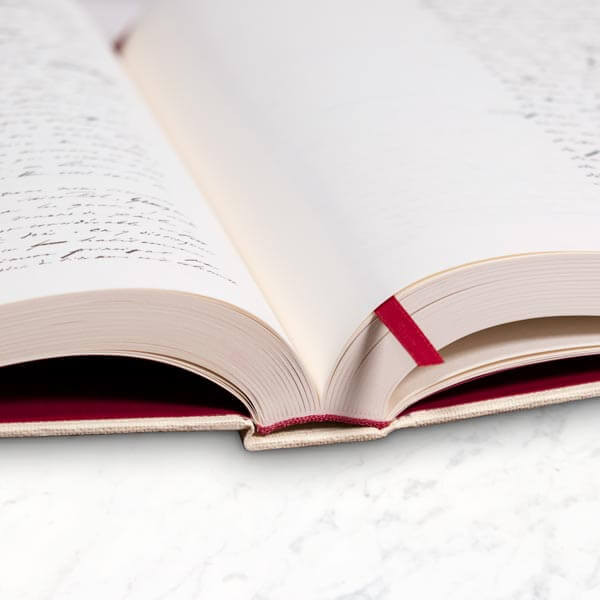
Presented in two volumes, the manuscript features a selection of 19th century engravings and drawings by Victor Hugo himself.

manuscript Victor Hugo Notre-Dame

Comments (7)
Grade

Manuscripts
