


 Free shipping
Free shipping on all orders 

Free shipping
Free shipping
CHARLES DICKENS: OLIVER TWIST
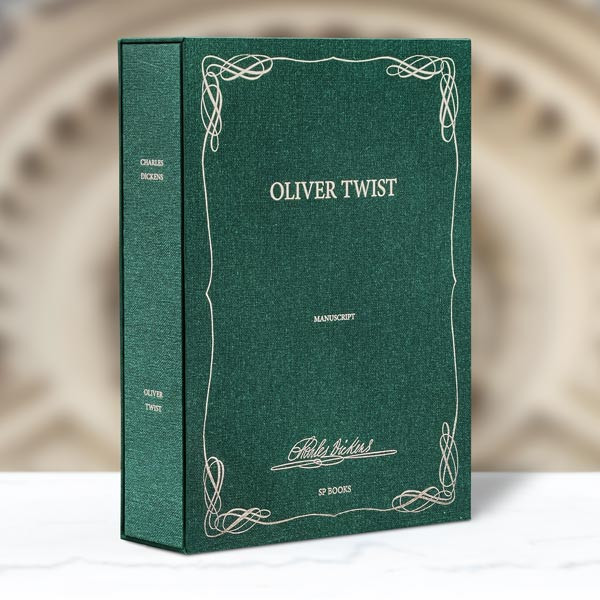
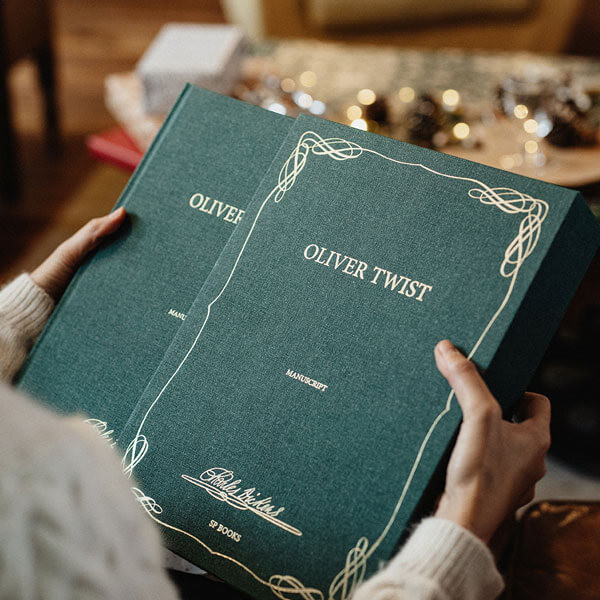
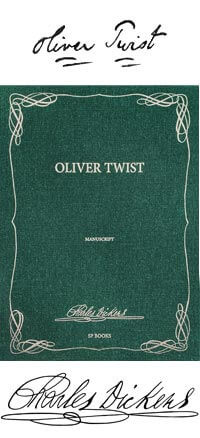
This volume is the first-ever reproduction in manuscript form of Oliver Twist.
Oliver Twist: facsimile edition of Charles Dickens’s manuscript
Oliver Twist remains among the “best loved and indeed most read of Dickens’s novels”, notes English writer Simon Callow. And yet, the original manuscript of the iconic tale had never been reproduced and presented to the public in print form yet. For the first time, Dickens’s original leaves are collected in a book.
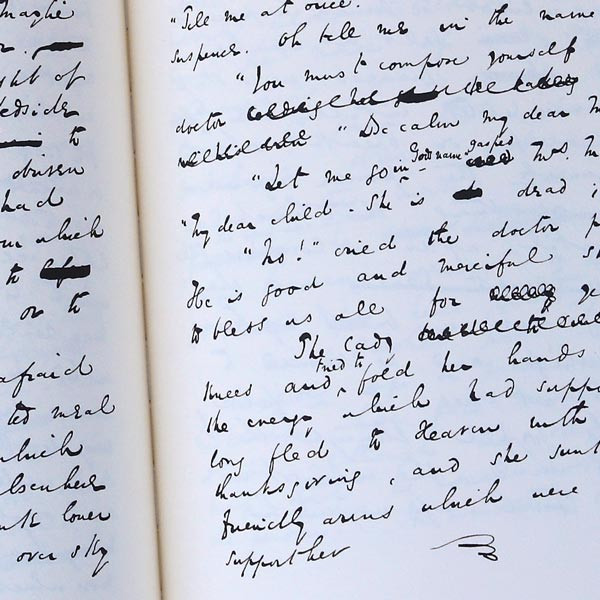
This bound volume features the reproduction of the original manuscripts kept in the National Art Library Forster Collection, at the prestigious Victoria and Albert Museum, London. It was also made in collaboration with the Charles Dickens Museum, who provided a manuscript leaf of Chapter Ten.
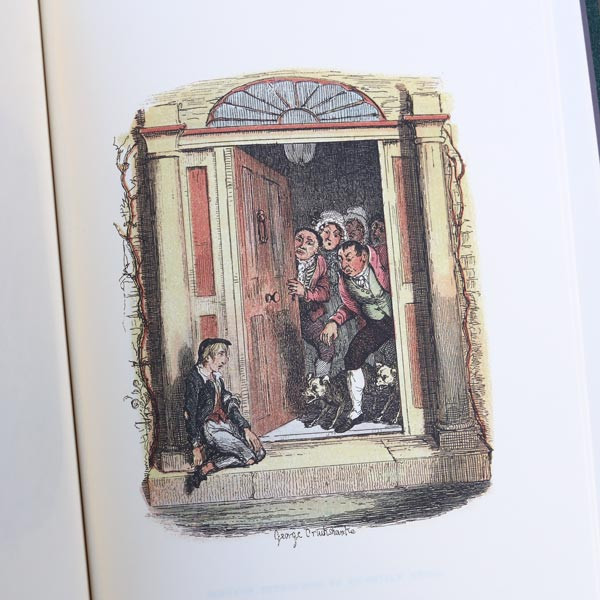
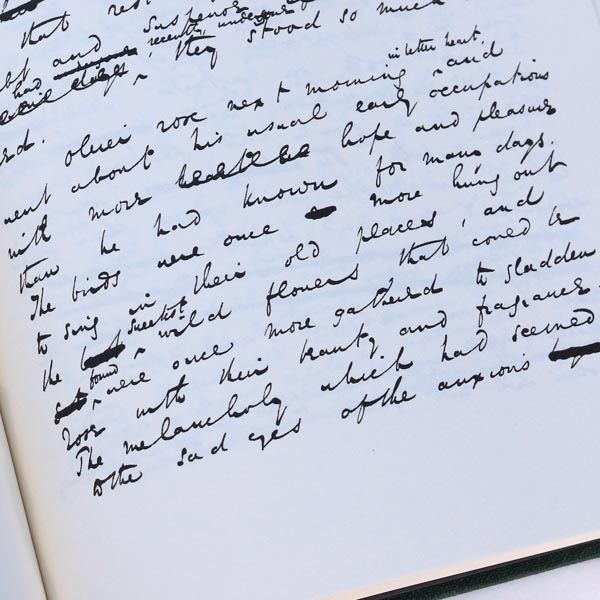
The manuscript pages, with Dickens’s additions and deletions, are enhanced with full-page colour illustrations made by George Cruikshank’s that appeared in a 1911 edition. The foreword is written by English actor, writer and Dickens specialist Simon Callow.
“I have thrown all my heart and soul into Oliver Twist” Charles Dickens
In early 1837, the first two chapters of Oliver Twist had just appeared in Bentley’s Miscellany, a new literary magazine founded by publisher Richard Bentley and of which Dickens was hired as editor-in-chief. Although just twenty-five years old, but already basking in the success of his first novel, The Posthumous Papers of the Pickwick Club, Dickens was able to predict, quite rightly, that his young orphaned hero, Oliver Twist, would become a household name.
“I have perhaps the best subject I ever thought of . . .”, he writes to his publisher, adding: “I have thrown my whole heart and soul into Oliver Twist, and most confidently believe he will make a feature in the work, and be very popular . . . ”
After the publication of the first two chapters, illustrated by renowned artist George Cruikshank, the popularity of Oliver Twist never ceased to grow. One thousand additional copies of the February issue of Bentley’s Miscellany were printed. Succeeding chapters, also accompanied by Cruikshank’s black-and-white engravings, appeared on a monthly basis until April 1839. Once published in book form, the novel continued to evolve as it passed through the hands of three publishers and was corrected at least four times. Dickens himself only ceased making changes in 1846, when it found its final form with the Bradbury and Evans edition.
The near-miraculous survival of the Oliver Twist manuscripts
With the publication of Oliver Twist, Charles Dickens became one of England’s most famous writers. But when, in 1839, he left the editorial staff of the magazine, he neglected to take the complete manuscripts with him—he began to keep the manuscripts of his novels after about 1840 only. He expressed regrets in a letter of 19 July 1840 to American author and diplomat Charles Edward Lester, noting that he “wished he had the complete manuscript of Oliver Twist, as it would one day have an interest for his children.” With this letter Dickens also sent Lester a “scrap” of the original manuscript—and vouched that it was a “portion of the original and only draught”, adding that he “never copied.”
The greater part of the manuscripts emerged when the Bentley’s premises were cleared out after Charles Dickens’s death on 9 June 1870: 474 folios corresponding to twenty-two chapters of the book—the other parts were probably lost before or during the clear-out. Sotheby’s put them up for auction on 23 July 1870 and John Forster, Dickens’s friend to whom he left the manuscripts of his major novels, bought them for £50. Upon his own death, Forster bequeathed his library and art collection to the Victoria and Albert Museum, where the manuscripts are now kept. Were it not for him, says Victoria and Albert Museum director John Meriton, they would have probably ended up burned.
A foreword by Simon Callow
In his preface to this volume (click here), writer Simon Callow tells the incredible story behind the manuscripts of Oliver Twist and Charles Dickens’s passion and urgency of writing. “To read the manuscript of Oliver Twist is to be plunged headlong into the most inconceivable waves of energy”, he writes, adding that it “shows us the young genius in the very act of mastering his craft.”
Simon Callow is an English actor, writer and theatre director who has also written extensively about Charles Dickens. His most recent publication is his 2012 biography of Dickens, Charles Dickens and the Great Theatre of the World.
The first restored reproduction of the original manuscripts
More than just ‘left-overs’, the manuscript of Oliver Twist is the living testimony of Dickens’s serialised novel, a form that imposed strong constraints on him since he had to keep readers in suspense at the end of each chapter while keeping the story coherent—with no opportunity to go back and edit. As Simon Callow writes in the foreword, it “testifies to the passion and urgency of his writing, as do the later corrections and alterations to the text.”
Now, at last, the handwritten pages, complete with Dickens’s additions, deletions and corrections, have been reproduced in printed form and with the pages enhanced by our team of specialised graphic artists. The effect has been to restore the document as near as possible to its original state, as if the ink were barely dry on the paper.
A colour version of George Cruikshank’s illustrations
George Cruikshank’s original engravings were black and white. In this edition, Cruikshank’s twenty-four illustrations have been taken from a colour version that appeared in a deluxe edition of Oliver Twist published almost a century after Dickens’s birth, in 1911.
George Cruikshank was born in London in 1792, twenty years before Charles Dickens’s birth in Portsmouth, in the South of England. Following the footsteps of his father, an established artist, he soon became a successful political cartoonist. In the 1820s, he turned to book and magazine illustration, gaining again notable success.
In 1836, when publisher Richard Bentley hired young Charles Dickens to become first editor of his new serial, he also asked brilliant artist George Cruikshank to provide black-and-white engravings for the magazine. Cruikshank would soon become the illustrator of Dickens’s early works: Sketches by Boz, The Mudfog Papers and Oliver Twist. From May 1837, he would provide two engravings for the Bentley’s: one for the serialised novel The Adventures of Oliver Twist; or, The Parish Boy’s Progress and the second for another text.
The first number of the Miscellany was released in January 1837 and in February, the first chapters of Oliver Twist appeared with Cruikshank’s engravings. Succeeding chapters, also accompanied with Cruikshank’s engravings, appeared on a monthly basis until April 1839, and the popularity of Oliver Twist never ceased to increase.
After Charles Dickens’s death in 1870, George Cruikshank claimed that it was he who had imagined Oliver Twist - an assertion that John Forster, Dickens’s friend and heir to his manuscripts, refuted. It is more likely that thorough Londoner Cruikshank and talented novelist Dickens had developed the initial idea together.
Your review appreciation cannot be sent
Report comment
Report sent
Your report cannot be sent
Write your review
Review sent
Your review cannot be sent


