
Previous
Next

The United States Declaration of Independence

€170.00

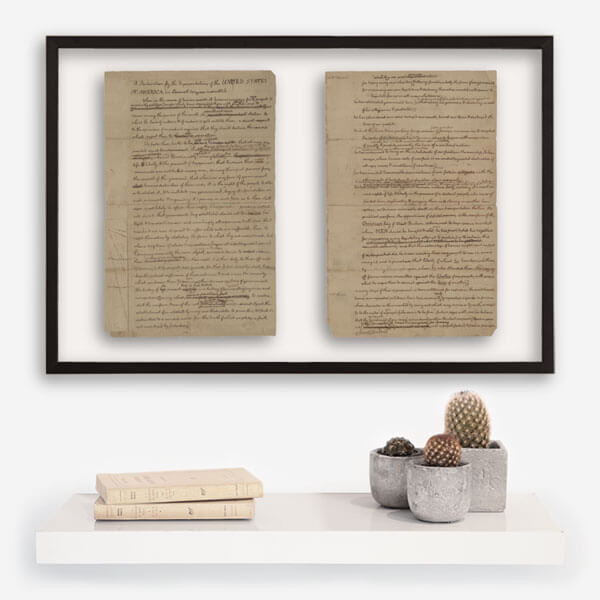
The US Declaration of Independence,
handwritten by Thomas Jefferson.

Double-sided document
Double-glass framing
25 x 17 frame

free shipping Free shipping 

€170.00

The US Declaration of Independence,
handwritten by Thomas Jefferson.

Double-sided document
Double-glass framing
25 x 17 frame

free shipping Free shipping 

The United States Declaration of Independence: the Manuscript

With the Bill of Rights in England in 1689 and the Déclaration des droits de l’homme et du citoyen (Declaration of the Rights of Man and of the Citizen) in France in 1789, the US Declaration of Independence remains one of the most fundamental documents of modern history. It is the first practical application of those freedoms and fundamental citizens’ rights determined by the philosophers of the Enlightenment.

The Manuscript of the United States declaration of independence by Thomas Jefferson

Approved on 4 July 1776, the Declaration of Independence constitutes the founding document of the United States of America. Affirming the independence of the Thirteen Colonies of North America from British rule, the text lays out the great founding principles of the nation, of equality, the right to life, liberty and the pursuit of happiness.

The birth of the American nation

In June 1776, after a year of war with British troops, the members of the Second Continental Congress prepared to declare the independence of the Thirteen Colonies of North America. On 7 June, Richard Henry Lee formally proposed a motion for their independence, known as the Lee Resolution, in which he declared that “all political connection between them and the State of Great Britain is, and ought to be, totally dissolved.”

Despite the disagreement of certain delegates, on 11 June Congress appointed a drafting committee of five members, comprising Thomas Jefferson, John Adams, Benjamin Franklin, Robert R. Livingston and Roger Sherman. Thomas Jefferson was chosen to draw up a first draft. Much influenced by the Enlightenment philosophers and in particular by the Second Treatise of Government by John Locke, it took him seventeen days to write a text that he perceived, in his own words, as “an expression of the American mind”.

On 21 June, Jefferson submitted the draft to the other members of the committee, who revised and edited it to produce a final version which was presented to Congress on 28 June. Congress accepted the draft after two days of extensive discussions and corrections, shortening the text by a quarter, moderating certain remarks and deleting a long paragraph in favour of the abolition of slavery.

Independence was declared on 2 July and on 4 July the text was officially approved and ratified. It was immediately printed and distributed throughout the country during July and August, and soon reached Europe.

Thomas Jefferson's original draft

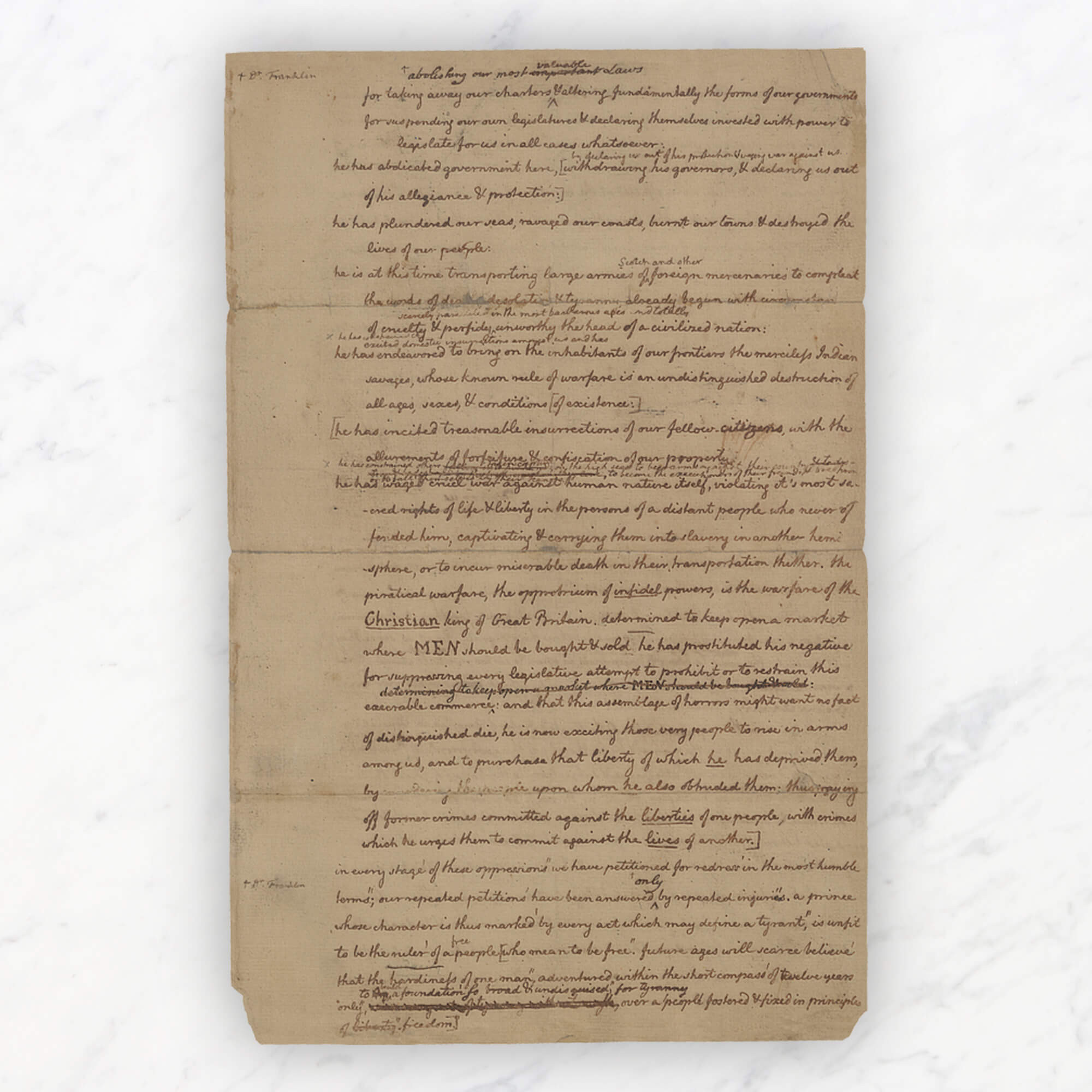
The document reproduced in this frame is Thomas Jefferson’s original draft, with his own crossings-out and corrections. While it was first thought to be the draft presented to the Committee of Five on 21 June, more recent studies suggest that it may be a revised version by Jefferson incorporating the alterations of the other members of the commission.

The fourth page reveals the passage concerning slavery that Congress ended up removing from the final version. Here, Jefferson condemns King George III of England for perpetuating the slave trade, and encourages those enslaved to revolt in accordance with their right to liberty.

declaration of independence USA - Facsimile

After 4 July, Thomas Jefferson kept his draft and even made copies of this version which he sent to friends, including Richard Henry Lee, in which he had highlighted passages deleted from the final text. The original document is kept in the Thomas Jefferson Papers, held in the Library of Congress Manuscript Division in Washington.

Thomas Jefferson, Congressman and Founding Father of the American nation

When he drafted the Declaration of Independence in the summer of 1776, Congressman Thomas Jefferson (1743-1826) was thirty-three years old. An avid reader and bibliophile, “while United States minister to France in the 1780s, Jefferson acquired thousands of books for his library at Monticello and by 1814 it had become the largest private library in America”. After his key role in establishing independence, he was chosen as Secretary of State in 1780 and on 4 March 1801 officially took his place as President.

Double-sided document presented in a double-glass framing (25 x 17").

Wooden frame, made in France. Each frame is hand-assembled in our workshops in Cambremer.

Comments (0)

Manuscripts
