

 Free shipping
Free shipping on all orders 

The Gettysburg Address
handwritten by Abraham Lincoln.
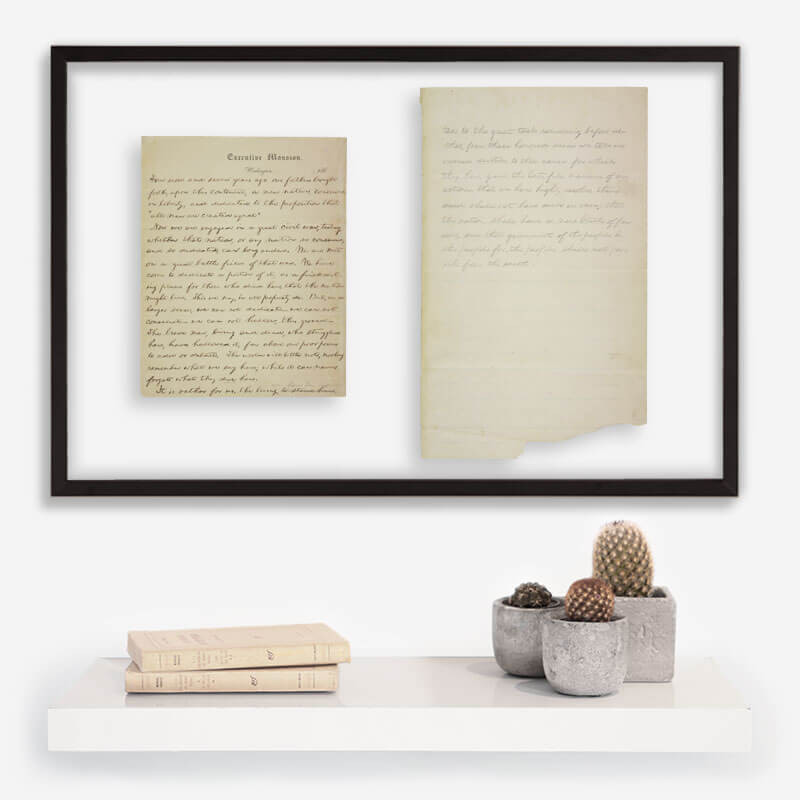
Double-sided document
Double-glass framing
25" x 17" frame
Free shipping
The Gettysburg Address
handwritten by Abraham Lincoln.
Double-sided document
Double-glass framing
25" x 17" frame
Free shipping
By 1863, the American Civil War had been raging for two years between the Union and the Confederacy. It had started on 12 April 1861 when the Confederate Army fired upon Fort Sumter and the conflict initially went in their favour. However, from 1-3 July 1863, the battle of Gettysburg in Pennsylvania marked the turning point of the war. After three days of fierce fighting, the Confederate troops, led by the commander Robert E. Lee, were forced to admit defeat. Several months later, a national cemetery was inaugurated on Cemetery Hill, in tribute to the victims of what would remain the bloodiest battle of the American Civil War.
On that day, Thursday 19 November 1863, it was the senator of Massachusetts Edward Everett who officially opened the ceremony with a two-hour speech. President Abraham Lincoln, who had travelled specially for the occasion, spoke afterwards. In only a few minutes he made his now iconic speech – possibly the most famous in American history – the “Gettysburg Address”.
“Four score and seven years ago...” With an opening that many Americans today know by heart, Lincoln described the Civil War as an essential stage in the development of America as a nation, that nation envisaged by the founding father in the Declaration of Independence. In only ten sentences, but with extraordinary eloquence, he described the fight led by the Northern states as a war fought for freedom, and the United States of America as a nation “conceived in Liberty, and dedicated to the proposition that all men are created equal”. He closed his speech by evoking one of the founding principles, the “government of the people by the people for the people”.
The day after the inauguration, the state senator of Massachusetts Edward Everett praised the President, writing, “I should be glad, if I could flatter myself that I came as near to the central idea of the occasion, in two hours, as you did in two minutes.”
There are five existing manuscripts of the speech known to date, all written by Abraham Lincoln and all showing variations. Only two were written around the time of the address. Known as the “Nicolay copy” and the “Haye copy”, they are named after the private secretaries to whom Lincoln gave them, John Nicolay and John Haye. The other three manuscripts were written by Lincoln well after November 1863, mainly for charitable purposes.
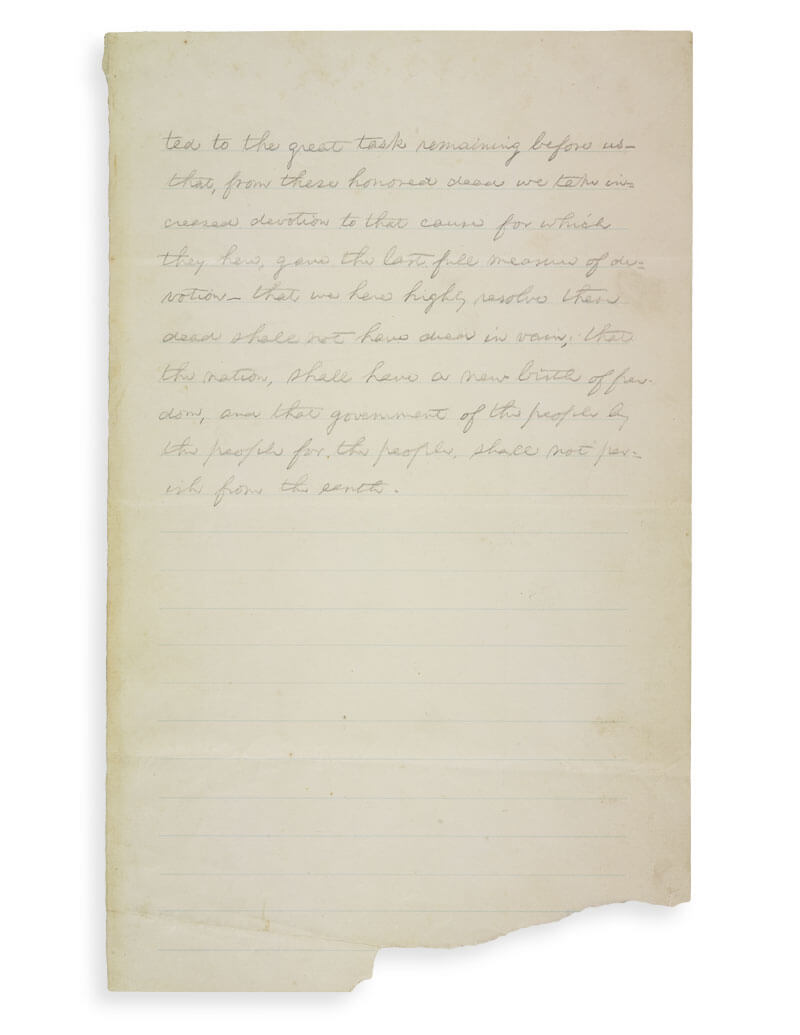
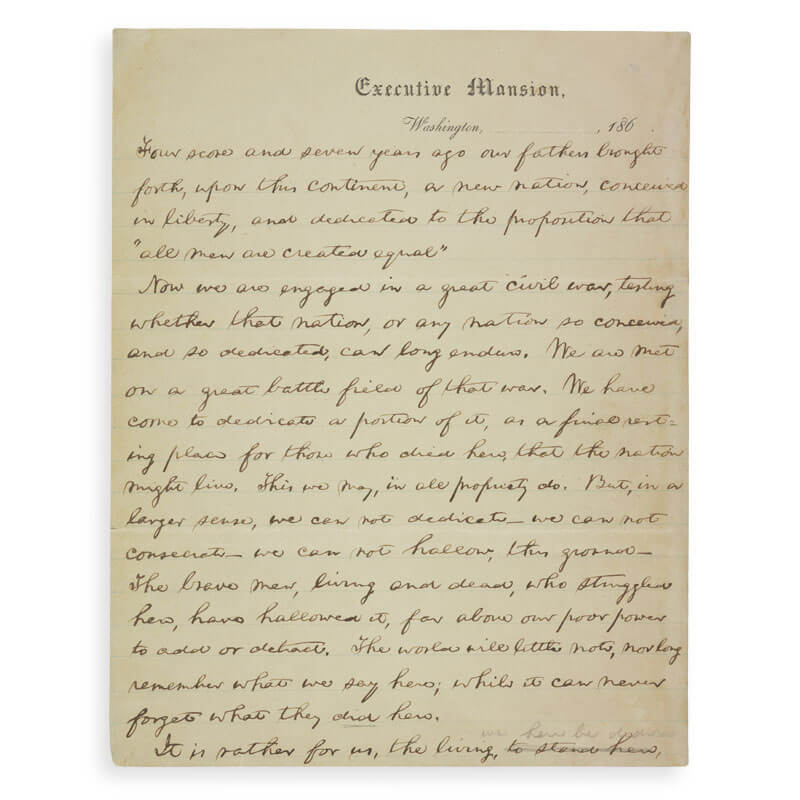
This two-page document, the “Nicolay copy”, is housed in the Library of Congress. Believed to be the earliest of the five manuscripts, it may even be the President’s only working draft.
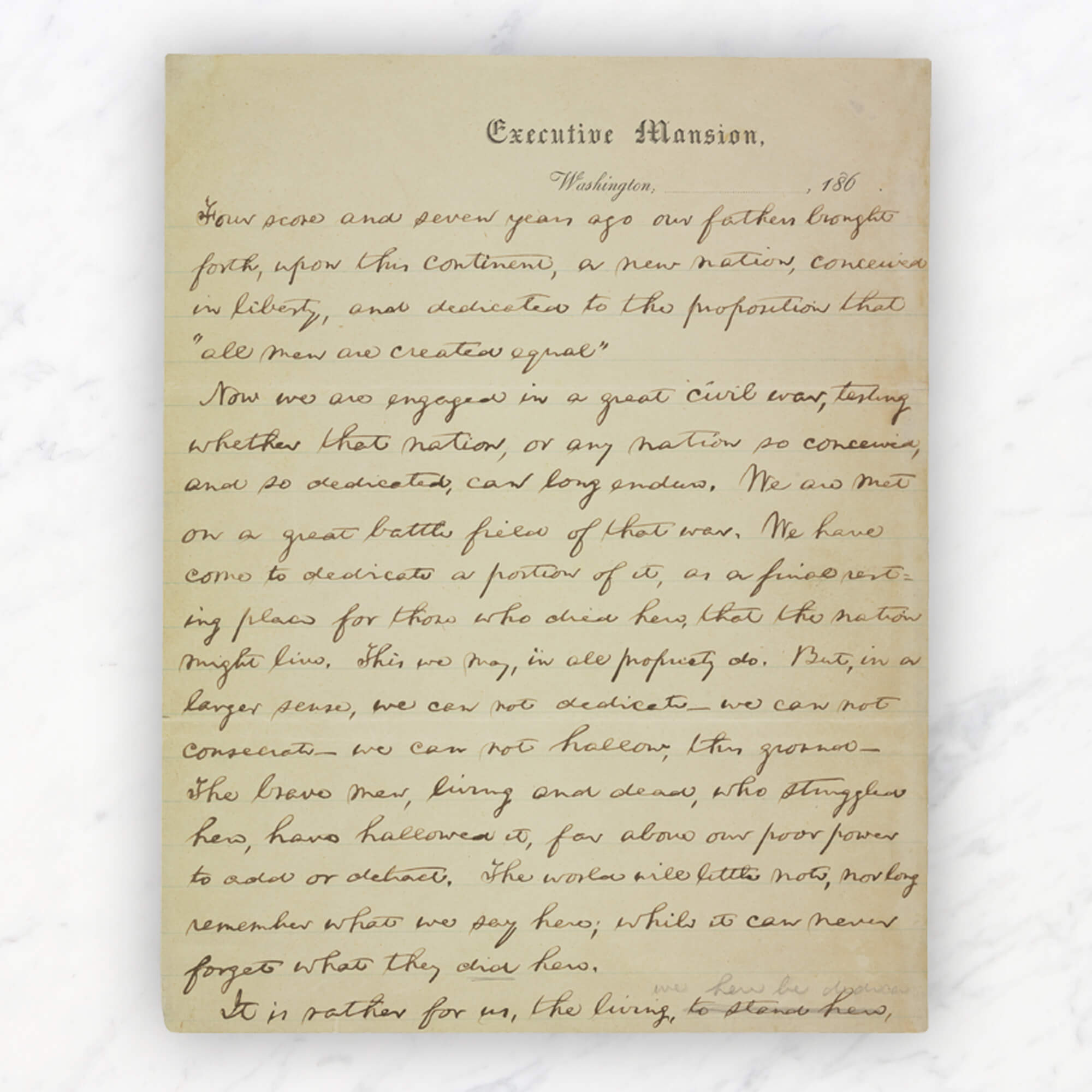
The first page is written in ink on the stationery of the Executive Mansion – now the White House – suggesting that it was written in Washington D.C. The second page is written in pencil on lined paper, indicating that Lincoln rewrote that part in Gettysburg while staying at the home of Judge David Wills. According to John Nicolay, who attended the ceremony, Lincoln had brought the first part of the speech with him and rewritten the second on the day, shortly before he spoke. As the President’s Private Secretary and guardian of his papers, John Nicolay kept the document until his death in 1901.
Gettysburg Address: transcript
Four score and seven years ago our fathers brought forth, upon this continent, a new nation, conceived in liberty, and dedicated to the proposition that "all men are created equal."
Now we are engaged in a great civil war, testing whether that nation, or any nation so conceived, and so dedicated, can long endure. We are met on a great battle field of that war. We have come to dedicate a portion of it, as a final resting place for those who died here, that the nation might live. This we may, in all propriety do. But, in a larger sense, we can not dedicate—we can not consecrate—we can not hallow, this ground—The brave men, living and dead, who struggled here, have hallowed it, far above our poor power to add or detract. The world will little note, nor long remember what we say here; while it can never forget what they did here.
It is rather for us, the living, we here be dedicated to the great task remaining before us —that, from these honored dead we take increased devotion to that cause for which they here, gave the last full measure of devotion—that we here highly resolve these dead shall not have died in vain; that the nation, shall have a new birth of freedom, and that government of the people by the people for the people, shall not perish from the earth.
Double-glass framing
Double-glass framing
Double-sided document presented in a double-glass framing (25 x 17").
Wooden frame, made in France. Each frame is hand-assembled in our workshops in Cambremer.
Your review appreciation cannot be sent
Report comment
Report sent
Your report cannot be sent
Write your review
Review sent
Your review cannot be sent


